

Higher-Calorie Infant Formula Nutrient Balance Guide
Introduction
Higher-calorie infant formula is simply formula with more energy per ounce than the standard 20 kcal/oz, used when a baby needs extra calories without being able to comfortably take more volume, and it only works well when the protein, fats, and micronutrients stay in a sane, development-supporting balance. That’s the whole game.
A lot of parents get sucked into brand wars, “clean ingredient” flexing, and marketing hype that makes it sound like one can is basically a diploma from Harvard. Meanwhile the real make-or-break stuff is boring: safe mixing, accurate measuring, a realistic calorie target, and a baby who actually tolerates the bottle.
If you’re here because weight gain feels slow, or the growth chart is doing that annoying flattening thing, or you’ve been told “let’s bump to 22” and nobody explained what that actually changes, good. This is the practical version. No mythology.
What makes a formula “higher-calorie”?

Standard energy density
Most standard formula in the U.S. is 20 kcal per ounce. Clinically, people often use breast milk as roughly comparable for simple math, which is helpful when you’re trying to sanity-check intake without turning into a spreadsheet person.
That 20 kcal/oz baseline matters because it’s the reference point behind a lot of guidance, and it’s what most “mix per label” directions are built around. Change the concentration and you change more than the calorie count. You change osmolality, you change renal solute load, you change how the stomach empties. Babies notice.
Common higher-calorie ranges
Higher-calorie ranges usually mean 22 kcal/oz, 24 kcal/oz, and sometimes 27 or 30 kcal/oz in more complex medical situations. In growth failure pathways, clinicians commonly use 24 to 30 kcal/oz as part of a structured plan rather than a DIY experiment, which is exactly how ASPEN frames supplementation when intake and growth aren’t keeping up.
Here’s the quick map people actually use in real life:
| Energy Density | Where It Usually Shows Up | Typical Vibe |
|---|---|---|
| 22 kcal/oz | Post-discharge preterm support, mild catch-up growth | “Nudge” without blowing up tolerance |
| 24 kcal/oz | Faltering growth plans, volume-limited babies | Common medical step-up |
| 27 kcal/oz | Higher-risk preterm, specific needs | Needs closer monitoring |
| 30 kcal/oz | Severe growth issues, specialty care | Not for casual home tinkering |
For preterm infants, some hospital co-management guidance keeps enriched feeds (often 22 to 27 kcal/oz) going after discharge for months, sometimes up to a year corrected age depending on risk and trajectory, which is the kind of detail you’ll see in places like the Children’s Hospital of Richmond nutrition guidance.
Medical vs retail options
Sometimes “higher-calorie” means a ready-to-feed product designed and tested at that density. Sometimes it means a pediatrician gives you a recipe to concentrate a standard powder. Those are not the same thing emotionally, because one feels safer, but both can be safe when you follow directions precisely.
What it does not mean: homemade recipe blogs, “stretching” a can by dilution, or winging scoop math at 2 a.m. Shortage panic is where people make the worst choices, and clinical teams have been blunt about avoiding improvised mixing because the harms can be immediate, as UCLA Health warned during the last major shortage.
How nutrient balance drives healthy weight gain
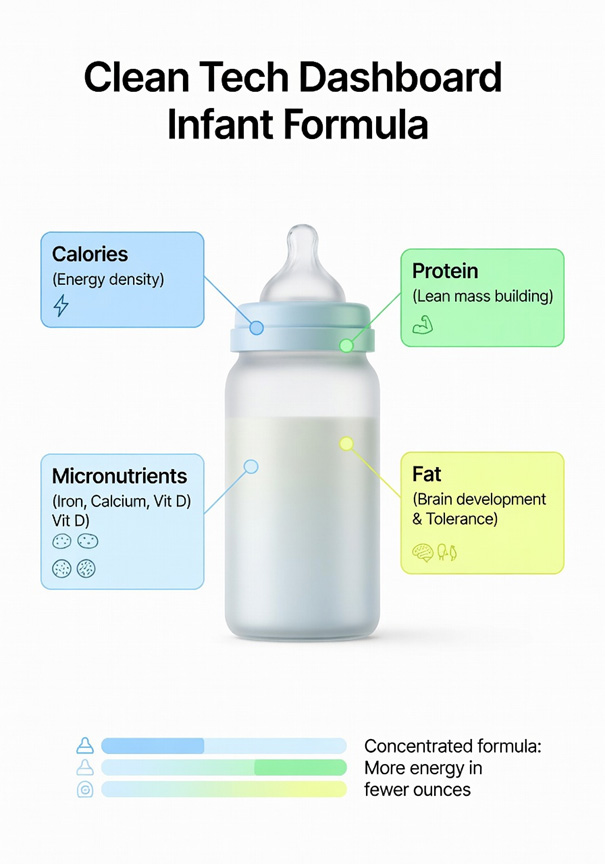
Calories are the headline. Nutrient balance is the plot.
If you push energy without enough protein, you can get weight without the kind of lean tissue you actually want. If you push concentration without respecting fluid needs, you can trade growth for constipation, dehydration, and a miserable tummy. Babies are petty like that.
Calories and volume tradeoffs
The main reason higher-calorie formula exists is volume limitation. Some babies cannot, will not, or should not take more ounces. Reflux. fatigue. cardiac or pulmonary workload. prematurity. oral-motor issues. Even just a kid who falls asleep mid-bottle every single time.
Concentrating a calorie formula lets you deliver more energy in fewer ounces, but it also raises the solute load the kidneys need to handle. The University of Washington’s guidance on concentrating formula gets right to the point about dehydration risk and renal strain when you go off-script.
So yes, calories help, but the “volume trade” is the quiet reason pediatricians like this tool.
Protein and fat roles
Protein is not optional background music. It’s structural. At the clinical level, catch-up growth targets often talk in protein-to-energy ratios because you need adequate protein to build lean mass, not just add mass. ASPEN’s growth failure materials get nerdy about this in a useful way, tying deposition of lean tissue to enough total energy and enough energy coming from protein.
Fat is the other heavyweight. It carries energy density and supports brain development, and the fat blend influences tolerance (stool texture, spit-up frequency, overall comfort). This is where two formulas with the same calories can behave differently in a baby’s body, and why “my friend’s baby did great on X” is not transferable as evidence.
Key micronutrients to watch
Micronutrients don’t get the internet’s attention because you can’t build an identity around magnesium. Babies still need it.
When you’re concentrating feeds or using enriched products, keep an eye on iron, calcium, vitamin D, and overall essential vitamins and minerals because the goal is complete nutrition, not just a heavier diaper. Preterm nutrition targets, like those discussed in AAP resources on the nutritional needs of the preterm infant, are built around matching fetal growth rates with appropriate macro and micronutrient delivery, not merely hitting a calorie count.
Also, “rapid weight gain” isn’t automatically a win. Higher-protein formulas have been studied for links to faster early gain compared with standard options, and the nuance matters because body composition and long-term outcomes don’t always move in lockstep, as research summaries like this PMC review on high-protein formula suggest.
Does your baby need more calories?

This is where you stop listening to vibes and start looking at patterns.
A baby who’s small but tracking their curve can be perfectly healthy. A baby who’s dropping percentiles, stalling, or not meeting intake expectations might need intervention. The intervention might be more calories. Or it might be treating reflux, fixing latch mechanics, addressing allergy, or dealing with an underlying condition. Nutrition is sometimes the symptom, not the cause.
Growth pattern signals
Growth charts are tools, not verdicts, but they’re the best shared language you and your pediatrician have. The red flags are usually about trajectory: crossing percentiles downward, poor velocity, or failure to regain appropriately after illness.
For catch-up growth in preterm infants, some clinical benchmarks talk about weight gain velocities around 30 to 35 grams per day in early life as a reference point, which you’ll see spelled out in guidance like Randall Children’s Hospital’s preterm nutrition document. Term infants have different expectations, but the point stands: trends matter more than single weigh-ins.
Intake and tolerance clues
Parents often miss the simplest clues because we’re trained to obsess over ounces and ignore behavior. These are the kinds of observations that actually help your clinician:
- The baby regularly can’t finish bottles or falls asleep early, even with consistent feedings.
- There’s frequent vomiting, escalating reflux, or persistent tummy troubles that cap intake.
- Diaper output changes alongside intake, especially fewer wet diapers or signs of dehydration.
None of that proves a calorie formulas switch is the answer. It just tells you whether “more volume” is realistic, and whether tolerance is already fragile.
When to call the pediatrician
Call when the growth curve flattens or drops, when intake is consistently low for age, when there are dehydration signs, or when you’re being tempted to start mixing “creative” bottles. Also call if you’re dealing with supply issues and considering switching products abruptly. During shortage cycles, pediatricians can often steer families toward safe substitutions and resources like WIC instead of letting you spiral, which is a point a pediatrician emphasized in a Time piece about navigating shortage decisions.
If your baby is preterm, medically complex, or has any chronic condition, involve your pediatrician early, not after you’ve already “trialed” three rich formulas and a new formula recipe you found on a forum.
Choose the right product and read labels
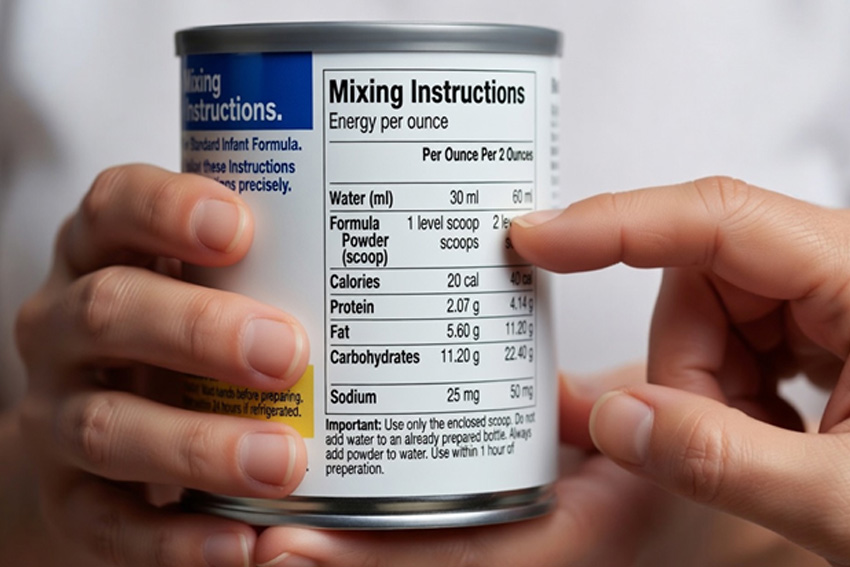
Label-reading is not a personality trait. It’s just risk control.
Energy per ounce and dilution rules
The label will tell you calories per serving and how that maps to prepared ounces. If your pediatrician wants 24 kcal/oz and the product is 20 kcal/oz standard, you need an explicit mixing recipe that has been validated for that product. Different powders pack differently, scoops vary, and “close enough” is how mistakes happen.
If you want a simple sanity-check for daily energy needs, there are weight-based estimates that clinicians use as a starting point, and consumer-facing explanations like this overview of calorie estimates by body weight can help you understand what your pediatrician is doing without pretending it’s perfect math.
I also like having a practical conversion anchor for bottle volumes since confusion between mL and ounces causes accidental underfeeding more often than anyone wants to admit, and this 20 kcal/oz equivalence explanation does that cleanly.
Protein type and fat blend
Protein type affects digestion, stooling, and spit-up for some babies. Fat blend can affect both tolerance and energy delivery. If your child is dealing with allergy concerns, specialized formulas matter and should be guided medically.
This is also where “organic formula” conversations get weird. Organic labeling tells you about agriculture standards for certain ingredients. It doesn’t automatically tell you how your baby will tolerate the protein, the carbohydrates, or the fat system.
Marketing claims vs evidence
Caregivers often perceive “modified” products as more premium or more medical, and research shows those perceptions are powerful enough that many people believe the extra cost is worth it, at least sometimes, as discussed in this Frontiers in Nutrition paper on caregiver perceptions. That’s not the same as outcomes.
If you feel yourself getting seduced by claims, pause and ask a harsh question: “What outcome is this claiming to improve, and what evidence would prove it?” It’s a useful mindset, and it matches what broader research has pointed out about how parents interpret formula marketing and health cues.
Use it safely and mix it correctly

Most failures with higher calorie formula are not the product. It’s the prep.
Wash hands. Use safe water per your pediatrician’s guidance. Use the correct scoop. Level it. Don’t pack it down like brown sugar. Measure water first unless your clinician tells you otherwise. Then add powder.
If you’re transitioning, do it deliberately. Some babies do fine with a direct switch. Others do better with a stepwise approach to avoid sudden stool changes, especially if they already have a sensitive tummy.
Three rules I wish were tattooed on every can:
- Don’t dilute bottles to “make it last.” That can cause electrolyte problems fast.
- Don’t concentrate beyond medical instructions because “more calories” seems better.
- Don’t add cereal or random fats unless your pediatrician explicitly prescribes it.
If you’re ever unsure whether you’re making the calorie formula correctly, stop and ask. This is not the place to be chill.
Track progress and know the risks
Monitoring is not obsessive. It’s how you stay safe.
Track intake honestly. Track diaper output. Track tolerance. Weight checks should follow your clinician’s plan, not your bathroom scale mood swings. UCSF Benioff Children’s Hospital’s inadequate growth guidelines are a good example of how multidisciplinary these plans can get when growth faltering is real, because it’s rarely just “swap the product and call it done.”
Risks to respect: dehydration, constipation, worsening reflux, and in some cases excessive solute load stressing immature kidneys. Higher density also changes how quickly a baby feels full, which can either help or backfire depending on the child.
Long-term outcomes are nuanced. Enriched formulas can improve short-term growth, but the developmental signal over time is mixed depending on population and context, which shows up clearly in reviews like this meta-analysis on nutrient-enriched formula outcomes.
One more thing, because people ask: regulation matters. The FDA has been actively reviewing nutrient requirements and testing standards in the wake of recent disruptions, and their Operation Stork Speed updates are a reminder that safety is not a vibes-based promise.
FAQ
How do I know if my baby is actually getting more calories?
By mixing exactly as directed (or exactly as prescribed) and tracking prepared ounces consumed. If you change concentration, your pediatrician should also tell you what to watch for in tolerance and diaper output.
Can I just switch to a higher-calorie formula from the store without asking?
If your baby is medically straightforward and you’re choosing a standard product at standard mixing, switching products is often fine. If you’re changing concentration or using a medical formula, involve your pediatrician.
Is constipation normal with higher-calorie formula?
It can happen because concentration changes water balance and digestion. If stooling changes sharply, or your baby seems uncomfortable, talk to your pediatrician before you “fix” it with unapproved additives.
How long do babies stay on enriched feeds?
It depends. Preterm infants may stay on higher-calorie formulas for months post-discharge depending on corrected age and growth, and pediatric teams often reassess as milestones and weight gain stabilize, similar to what AAP discharge nutrition discussions emphasize.
Conclusion
If you strip away the internet noise, higher-calorie infant formula is a clinical tool for a specific problem: getting enough energy and nutrients into a baby who cannot meet needs by volume alone. The winning strategy is almost boring: pick the right product, mix it correctly, transition thoughtfully, and monitor growth and tolerance with your pediatrician so you’re aiming for steady growth, not just a heavier number.